
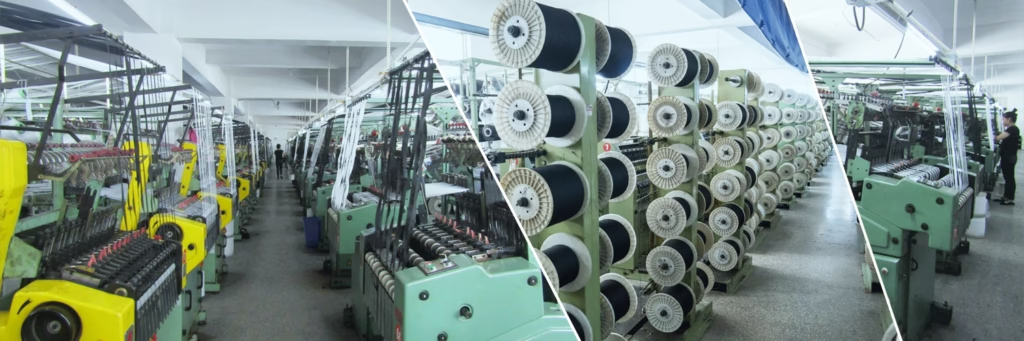
Nylon zippers dominate the zipper market today due to their low cost, high industrial scalability, and versatility. However, many experienced manufacturers agree: making a functional nylon zipper is easy, but making a truly high-quality, consistent one is extremely difficult.
Why? Because every step—from raw materials to finished products—introduces variables. This article breaks down the challenges across four parts: Overview, Yarn, Monofilament, and Processes, along with practical solutions.
Part 1: Overview – Why “Doing It Well” Is So Hard
When I first entered the industry, I was told: nylon zippers are the easiest to make, metal zippers the hardest, and resin zippers in between. Over time, I realized this was misleading.
The truth: Making a working nylon zipper is easy. But making one with stable quality, batch after batch, is extremely hard.
- Nylon zippers involve plastic teeth (PET/PA) and textile tape (various yarns).
- Temperature, tension, humidity, and load conditions constantly change.
- Every process step adds variables. Only precise process control ensures consistency.
Main types of nylon zippers (now more accurately called polyester zippers):
- Standard nylon zippers (sportswear, outdoor gear)
- Invisible zippers (mostly nylon)
- Woven zippers (teeth and tape woven together in one process)
Advantage: low cost, mass production friendly.
Disadvantage: extreme sensitivity to heat, tension, and humidity.
Part 2: Yarn – The Heaviest and Most Overlooked Variable
In a standard nylon zipper, yarn accounts for 50%–60% of the total weight. It is the most important raw material.
| Issue | Consequence | Solution |
|---|---|---|
| Batch variation | Different dye uptake → color difference after dyeing | Use same batch from same supplier; no mixing |
| Recycled yarn | Lower strength and dyeability | Avoid or strictly control |
| Oil content | High-viscosity or non-water-soluble oil → difficult to remove, stains fabric, affects dyeing | Use standard water-soluble oil; control oil content |
Part 3: Monofilament – The Core of Tooth Performance
Nylon zipper teeth are formed by spiral winding of monofilament (extruded from PET chips). Monofilament stability directly determines tooth meshing and dimensional consistency.
| Variable | Impact |
|---|---|
| Diameter | Example: #5 zipper standard = 0.74mm. ±0.01mm changes tooth size and thickness. |
| Shrinkage | Wet shrinkage (dyeing) vs. dry shrinkage (setting) mismatch → batch variation |
| Viscosity (hardness) | Too soft → deforms; too hard → damages machinery |
| Dye uptake | Different TiO₂ content → tooth/tape color mismatch |
| Roundness | Non-round monofilament causes tooth size and width fluctuation |
⚠️ Common mistake: Inconsistent tooth size is often blamed on the machine, but the real cause is usually monofilament diameter or roundness variation.
Solutions for monofilament control
- Strict incoming inspection (diameter, roundness, shrinkage)
- Do not change monofilament suppliers or formulas easily
- Operators must adjust machine parameters based on monofilament variables
Part 4: Processes – Every Step Is a Potential Problem
Even with stable raw materials, manufacturing processes introduce many variables.
1. Weaving Process (Tape Production)
- Contamination: Machine gear oil (heavy oil) is hard to remove → stains on final product.
- Thickness & density variation: Affects strength and fit.
- Inconsistent arc/curve: Different tape arcs cause mismatched zipper feel.
• Use large creels; replace warp beams every 4 months
• Standardize tape arc across hundreds of looms (e.g., around 2.5°)
• Improve tape flatness to avoid wrinkles
2. Coil Forming & Sewing
- Temperature, tension, and mandrel precision must be constant
- Sewing stitch pitch or tension deviation → skipped stitches or thread breakage
3. Dyeing & Finishing
- Nylon is sensitive to temperature and pH
- Uneven dyeing or inconsistent shrinkage → arching or curling
- Thermal shrinkage is much higher than metal zippers → temperature mistakes deform the entire zipper
Summary: Making a Good Nylon Zipper = Controlling Variables
A nylon zipper is difficult to make not because the technology is unattainable, but because:
“There are too many variables from yarn to monofilament to every process step. Any fluctuation is magnified in the final product.”
To produce stable, high-quality nylon zippers, you must:
- Strictly control raw material batches
- Stabilize yarn and monofilament specifications
- Inspect diameter, roundness, shrinkage, and oil content
- Standardize tape arc and flatness
- Implement precise process control between every step
A truly reliable nylon zipper can never be a “cheap viral product.” But with systematic variable control, it is absolutely possible to make excellent, consistent nylon zippers.

